
Quick Summary
While garage door openers generally last 10 to 15 years, coastal Florida heat, humidity, and airborne salt often reduce that operational lifespan to 8 to 12 years. Superior Garage Door Experts Port Charlotte recommends following the 50 percent rule, advising homeowners to repair minor component issues on newer units but replace systems nearing a decade of use or lacking modern safety sensors. After reading this guide, you will be able to spot critical failure symptoms such as stripped drive gears and corroded logic boards to determine whether your system requires a fast repair or a full replacement.
How Long Do Garage Door Openers Last: Repair or Replace?
If you want to know how long do garage door openers last, the standard answer from most manufacturers is 10 to 15 years. In coastal Florida, however, that number tells only half the story. High summer heat, heavy humidity, and salt air can wear down sensitive circuit boards and electric motors several years ahead of schedule. When an opener starts acting up, homeowners in Port Charlotte and surrounding coastal towns need an honest assessment: is it an inexpensive fix, or is the unit at the end of its life?
Our technicians at Superior Garage Door Experts Port Charlotte handle these issues every day. We carry common replacement parts, from stripped drive gears to fresh logic boards, so we can fix what is broken on the spot or install a reliable new motor if replacement is the better path. Here is what you need to know about opener lifespan, common failure signs, and how to decide between repair and replacement.
What Is the Average Lifespan of a Garage Door Opener?
Average Lifespan in Brief: A typical residential garage door opener lasts between 10 and 15 years, or roughly 10,000 to 15,000 operating cycles. In coastal areas with high humidity and heat, that lifespan often falls to 8 to 12 years because electronics and capacitors wear down faster than the mechanical motor itself.
When manufacturers estimate how long an opener will last, they measure by cycles rather than calendar years. One complete cycle means the door opens and closes once. If your family uses the garage as the main front door, cycling it four to six times a day, the unit will reach its mechanical limit years sooner than a door on a seasonal property.
National Averages vs. Real-World Cycle Count
Most residential openers are engineered for 10,000 to 15,000 cycles. Under normal conditions with balanced springs and smooth rollers, a quality unit easily reaches the 12-year mark. But if your door is out of balance, the motor has to pull heavy dead weight on every run. That extra drag strains internal gears and cuts down your overall garage motor lifespan.
In Southwest Florida, unconditioned garage spaces act like ovens for six months of the year. Ambient garage heat regularly climbs past 120 degrees, drying out factory grease and stressing electronic components long before the mechanical motor wears out.
Lifespan by the Numbers
| Daily Usage Level | Estimated Daily Cycles | National Baseline Lifespan | Coastal / High-Heat Lifespan |
|---|---|---|---|
| Light | 1 – 2 cycles | 13 – 15+ years | 10 – 12 years |
| Moderate | 3 – 4 cycles | 10 – 12 years | 8 – 10 years |
| Heavy | 5+ cycles | 7 – 9 years | 5 – 7 years |
Keeping an eye on your household’s daily cycle count gives you a realistic idea of when to replace garage opener hardware before a sudden motor breakdown leaves your vehicle stuck inside.
How Coastal Florida Climate Accelerates Opener Wear
Need how long do garage door openers last?
We’re available now — call for a fast, free estimate.
The local climate in Charlotte County is tough on mechanical and electronic equipment. While a garage door opener lifespan in a mild Midwestern climate might reach 15 years, unconditioned garages in our area face two major threats: circuit board corrosion and intense thermal buildup.
Logic Board and Circuit Board Corrosion
Airborne salt and persistent humidity penetrate the plastic housing of your opener. Over time, that damp, salty air oxidizes the solder joints on the logic board, ruins the motor start capacitor, and corrodes the low-voltage terminals wired to your safety sensors. On top of the humidity, Southwest Florida experiences frequent lightning storms that create power spikes. A surge can instantly fry an unprotected logic board, even on an opener that is only a few years old.
Extreme Garage Heat and Thermal Overload
During peak summer months, closed garages trap hot air, driving internal temperatures up to 130 degrees Fahrenheit. Electric motors generate their own heat while operating, and when surrounded by extreme ambient heat, they struggle to cool down. This environment degrades the motor winding insulation and trips internal thermal overload switches. If your opener stops halfway through a cycle on a hot July afternoon, the motor is likely overheating.
Clear Signs Your Garage Door Opener Is Dying
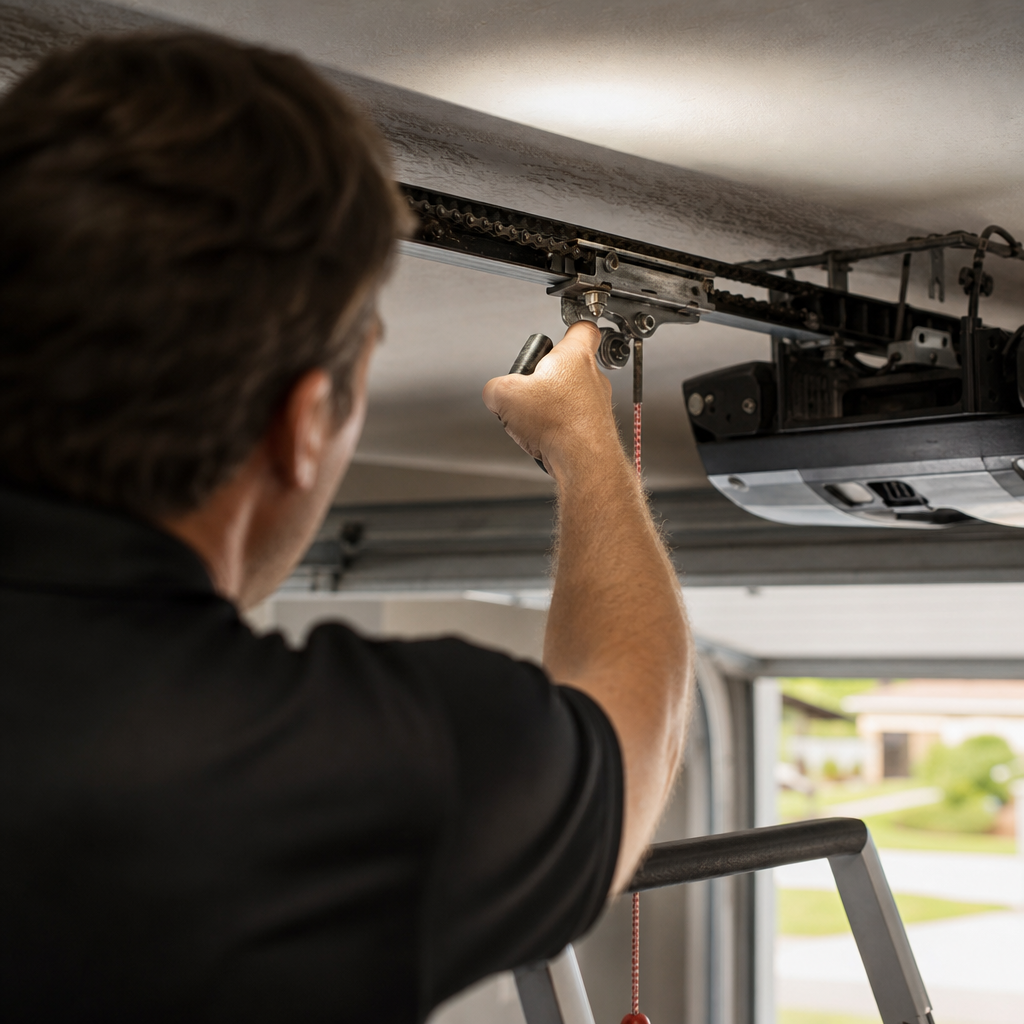
Openers rarely fail without warning. Paying attention to these early symptoms helps you avoid getting stuck with a door that will not open when you need to leave for work.
Unusual Grinding or Straining Motor Noises
If you hear the motor running but the chain or belt does not budge, the internal drive gear has likely stripped out. Most modern openers use a white nylon gear designed to wear down first to protect the motor from burning out. When this gear sheds its teeth, you will hear a loud whirring sound, and you might spot small white plastic shavings inside the opener cover. Squealing, grinding, or groaning sounds usually point to heavy mechanical strain caused by broken counterbalance springs or worn-out rollers.
Intermittent Remote and Sensor Problems
If your remotes or wall buttons work only part of the time, the issue usually traces back to a failing receiver on the logic board or loose, corroded wiring. As Superior Garage Door Experts Port Charlotte points out, in coastal neighborhoods, safety sensors often develop corrosion at the wire terminals, causing the door to stop and reverse for no visible reason.
Hesitation, Stalling, or Slow Movement
When an opener hesitates right after you press the button, or moves noticeably slower than it used to, the motor capacitor or internal drive assembly is failing. Before replacing the entire unit, an experienced technician will check whether the motor is dying or if the door simply needs fresh springs and a track tune-up.
Lifespan by Drive Type: Belt vs. Chain vs. Screw vs. Wall-Mount
Need how long do garage door openers last?
We’re available now — call for a fast, free estimate.
The type of drive mechanism plays a major role in how long the unit lasts, especially in humid and coastal environments.
| Drive Type | Typical Lifespan | Corrosion Resistance | Noise Level | Best Application |
|---|---|---|---|---|
| Belt Drive | 12 to 15+ Years | High | Very Low | Attached garages, bedrooms overhead |
| Chain Drive | 10 to 15 Years | Moderate to Low | Moderate to High | Detached garages, heavy carriage doors |
| Wall-Mount (Jackshaft) | 12 to 15 Years | High | Minimal | High ceilings, cathedral garages |
Chain Drive Openers (10 to 15 Years)
Chain drives use an all-metal chain and cable assembly to pull the door. They are strong and budget-friendly, making them great for heavy doors. However, without regular lubrication, the steel chain and sprockets will develop surface rust in our humid air, leading to rougher operation and extra motor drag.
Belt Drive Openers (12 to 15+ Years)
Belt drives use a steel-reinforced rubber or polyurethane belt. Because there are no exposed metal links to rust, they handle coastal humidity exceptionally well. They run smoothly, generate minimal vibration, and protect the overall garage motor lifespan by reducing mechanical shock during start and stop phases.
Screw Drive and Wall-Mount Jackshaft Units
Screw drive openers turn a threaded steel rod to move the trolley. They have fewer moving parts, but extreme temperature shifts can thin out the grease along the rail, causing friction. Wall-mount jackshaft models mount directly to the wall beside the torsion bar. By eliminating the ceiling-mounted rail, they reduce vibration and free up overhead storage space.
Repair vs. Replace: Decision Rules for Aging Openers
Deciding whether to repair or replace an opener comes down to three factors: age, repair cost, and safety features.
The 50 Percent Rule
According to Superior Garage Door Experts Port Charlotte, a good rule of thumb is the 50 percent rule. If the estimated repair cost is more than half the price of a brand-new opener installation, replacing the unit is usually the smarter financial decision. If your opener is less than eight years old and needs a minor fix – such as a new set of safety eyes, a fresh capacitor, or a replacement drive gear – a simple repair makes practical sense. But if the unit is 12 years old with a fried logic board, putting money into an aging motor is rarely worth it.
Safety and Modern Features
Sometimes replacement is necessary purely for safety and compliance:
- Pre-1993 models: Any opener built before 1993 lacks modern infrared safety sensors that reverse the door automatically if something is in the opening. These units present serious safety risks and should be replaced.
- Rolling-code security: Older fixed-code openers can be intercepted by signal grabbers. Modern units generate a brand-new security code with every click.
- Battery backup: During storm season in Florida, power outages are common. Modern openers with integrated battery backups let you open your garage door and evacuate your vehicle even when the main power is down.
- Smart monitoring: Built-in Wi-Fi lets you check if the door was left open, receive alerts, and control access directly from your phone.
Frequently Asked Questions
Can a garage door opener last 20 years?
A few older, heavy-duty mechanical openers do reach the 20-year mark if they see very light use. However, keeping a 20-year-old opener running is rarely a good idea. Units from that era lack modern auto-reverse safety sensors, rolling-code anti-theft protection, and reliable replacement parts.
How often should garage door openers be serviced?
Having your opener and door system inspected once a year helps prevent premature gear failure. Regular service includes testing the balance of the door, inspecting the drive belt or chain tension, lubricating moving parts, and verifying the auto-reverse safety settings.
Does a heavy wind-rated door reduce opener lifespan?
A wind-rated or hurricane-impact door will not wear out an opener if the counterbalance springs are properly tuned. The torsion springs do all the heavy lifting; the opener simply guides the door up and down. If the springs are weak or out of balance, the motor has to pull dead weight, which ruins the internal gears quickly.
How do I know if my problem is the opener or the door itself?
Pull the red emergency release cord while the door is closed, then lift the door manually by hand. If the door feels heavy, catches on the tracks, or slams down when you let go, your springs or tracks need service. If the door opens smoothly with one hand and stays balanced at waist height, the issue is inside the opener motor or logic board.
Need how long do garage door openers last?
We’re available now — call for a fast, free estimate.
Frequently Asked Questions
How can I protect my garage door opener from coastal Florida power surges?
You can safeguard sensitive logic boards by plugging the motor unit into a dedicated single-outlet surge protector designed for garage openers. Superior Garage Door Experts Port Charlotte also recommends routine maintenance to clean salt residue off wiring terminals before storm-related voltage spikes cause permanent damage.
Which garage door opener drive type lasts the longest in humid coastal climates?
Belt-drive openers with steel-reinforced polyurethane belts offer the greatest durability near the coast because they have no exposed metal links to rust. Wall-mount jackshaft systems are another resilient choice, keeping the motor protected and reducing vibration stress on overhead brackets.
How do I know if an aging garage door opener is an urgent safety hazard?
An opener is unsafe if it fails the auto-reverse safety test, lacks infrared photo eyes, or exhibits severe logic board lag when closing. Superior Garage Door Experts Port Charlotte can perform a comprehensive safety inspection to determine whether replacing the motor is necessary to restore safe operation.
About the author
 |
Marcus Henderson Marcus brings over 12 years of hands-on experience in residential and commercial garage door systems to his writing. A former certified technician with the International Door Association (IDA), he uses his deep understanding of garage door mechanics to help homeowners maintain secure and functional properties. He specializes in practical advice on emergency repairs, preventative maintenance, and upgrading home security. |