
Quick Summary
Explaining what is a torsion spring, this guide details how overhead counterbalance systems store rotational torque to lift heavy garage doors while highlighting the severe safety risks associated with high-tension hardware failure. Because coastal humidity and operational cycling lead to metal fatigue, Superior Garage Door Experts Port Charlotte emphasizes that broken springs require professional, same-day replacement rather than hazardous DIY handling. Readers will understand the mechanics of torsion assemblies, identify critical warning signs of impending spring breaks, and know when to schedule expert inspections to safely restore balanced door operation.
What Is a Torsion Spring?
A torsion spring is a tightly wound steel coil that works by twisting along its axis. Rather than stretching like a rubber band, it resists rotational force (torque) and stores mechanical energy as it is wound. When that energy is released, the spring exerts an equal force in the opposite direction.[4]
In residential applications, as noted by Superior Garage Door Experts Port Charlotte, torsion springs are used in overhead door counterbalance systems to offset the weight of the door, allowing it to open and close smoothly manually or with an electric motor. Because these springs operate under high mechanical tension, improper handling and failures are associated with serious injury risk. When a spring fails, safe and prompt repair is necessary to restore proper operation.[1]
What Is a Garage Door Torsion Spring and How Does It Work?
In an overhead door counterbalance system, torsion springs are mounted horizontally on a shaft above the door opening. The system transfers the spring’s rotational force through the shaft to drums and lifting cables connected to the door.
Mechanical Function: Storing and Releasing Rotational Energy
The operation of garage door torsion springs involves managing torque across phases of door movement:
- Energy Storage (Closing): As the door lowers, cables turn the shaft, winding the spring tighter and storing mechanical energy in the coil.
- Energy Release (Opening): When the door opens, the spring unwinds, releasing its stored rotational energy through the shaft and drums to help lift the door.
- Equilibrium (Resting): When the door is at rest, calibrated spring tension holds the system in place and maintains proper cable tension.
Key Components of a Modern Torsion Assembly
A standard overhead door counterbalance system consists of several interconnected components:
- Torsion Shaft and Center Bearing Bracket: A shaft mounted above the door opening, supported by a center bracket that secures the stationary end of the spring.
- Winding and Stationary Cones: Fittings on the ends of the spring used to secure the stationary end to the bracket and wind tension into the spring on the shaft.
- Cable Drums and Lift Cables: Drums at each end of the shaft that spool and unspool cables connected to the bottom of the door.
Torsion Springs vs. Extension Springs: Key Differences
Overhead door systems generally use either torsion springs or extension springs to counterbalance door weight, though their mechanical design and placement differ.
Mounting Location and Mechanical Action
Torsion springs mount directly above the door opening on a shaft and operate by twisting along their axis. Extension springs mount along the upper horizontal door tracks and operate by expanding and stretching linearly.
Safety, Durability, and Operational Lifespan
Because torsion springs are installed over a central shaft, the shaft helps contain the coil if a break occurs. Torsion systems generally provide balanced door movement and consistent operational performance.
| Feature | Standard Torsion Springs | Galvanized Torsion Springs | Extension Springs |
|---|---|---|---|
| Mounting Location | Above door header on shaft | Above door header on shaft | Parallel to horizontal tracks |
| Mechanical Action | Rotational torque (twisting) | Rotational torque (twisting) | Linear tension (stretching) |
| Safety Containment | Contained by center steel shaft | Contained by center steel shaft | Requires internal safety cable |
| Corrosion Resistance | Standard | Higher (coated finish) | Standard |
Why Torsion Springs Degrade in Humid Coastal Environments
Need what is a torsion spring?
We’re available now — call for a fast, free estimate.
In coastal environments, atmospheric moisture and exposure can influence the rate of hardware wear and corrosion.
Salt-Air Oxidation and Micro-Fracturing
Exposure to moisture and airborne salt can accelerate oxidation on bare steel springs. Over time, surface rust and continuous mechanical cycling under tension can weaken the metal, eventually contributing to spring failure.
Thermal Expansion and Garage Heat
Temperature fluctuations and elevated humidity in garage spaces can contribute to metal fatigue over time. Routine lubrication helps protect steel surfaces, while coated or galvanized springs offer additional resistance to humid conditions.
Warning Signs of a Broken Torsion Spring and Safety Risks
Torsion springs are under tension during operation and can break when under load.
Visible and Audible Symptoms of Spring Failure
Common signs that may indicate a broken spring include:
- A loud sound: A spring breaking under torque typically produces a loud noise.
- A visible gap in the spring coil: A broken torsion spring usually shows a distinct separation where the steel has snapped.
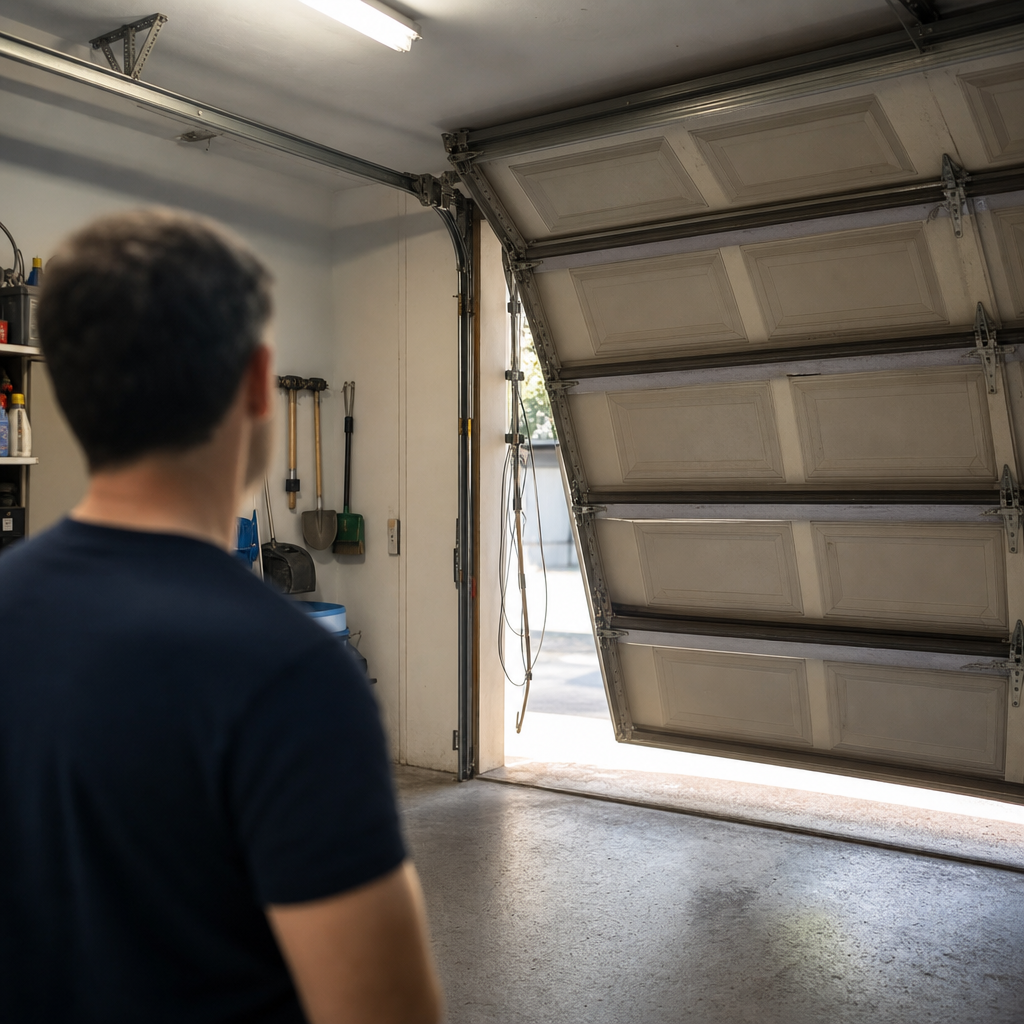
- The door opens only partially: An automatic opener may stop after lifting only slightly due to the unassisted weight of the door.
- Loose lift cables: When spring tension is lost, the lifting cables may lose tension or slip from the drums.
Safety Hazards of High-Tension Hardware
Torsion springs store substantial mechanical energy. Improper handling and hardware failures are associated with serious injury risk. According to Superior Garage Door Experts Port Charlotte, adjusting or servicing torsion hardware requires specialized tools and technical knowledge.[3]
Professional Torsion Spring Replacement
Trained technicians replace worn or broken springs and adjust the counterbalance system to ensure proper operation.
Hardware Matching and Cycle Ratings
Spring replacement requires matching the spring dimensions, wire size, and length to the door’s specifications. On systems with two springs, replacing both at the same time is common practice since both springs have experienced similar operational wear.
System Balance and Safety Inspection
Proper service includes checking related hardware, setting cable tension, and testing manual balance so the door operates smoothly along the tracks.
Frequently Asked Questions About Garage Door Torsion Springs
What is the main purpose of a garage door torsion spring?
The primary purpose of a torsion spring is to counterbalance the weight of the overhead door. By storing and releasing rotational force, it allows the door to be opened and closed with minimal effort manually or via an automatic opener.[5]
Can an automatic opener lift a door with a broken torsion spring?
Automatic openers are intended to guide a balanced door rather than lift the unassisted dead weight. Attempting to operate an opener with a broken spring can strain or damage the opener motor and drive components.
How long do garage door torsion springs typically last?
Torsion spring life is measured in operational cycles, where one cycle represents a complete opening and closing sequence. As explained by Superior Garage Door Experts Port Charlotte, actual lifespan varies based on daily usage frequency, maintenance, and environmental conditions such as humidity.[2]
How much does professional torsion spring replacement cost?
The cost of professional replacement depends on factors such as whether the door uses a single or dual-spring configuration, the required spring specifications, and local labor rates.
Need what is a torsion spring?
We’re available now — call for a fast, free estimate.
Sources
- Preliminary Determinations in the Antidumping Duty Investigations … – trade.gov (2025)
- Fatigue Life Analysis of Titanium Torsion Spring Based on Continuous Damage Mechanics – PubMed – pubmed.ncbi.nlm.nih.gov (2025)
- 2020 NEISS brochure – cpsc.gov (2020)
- Torsion Spring – Spring Market Statistics, 2024 – 2030 – grandviewresearch.com (2030)
- Torsion spring – Wikipedia – en.wikipedia.org
Related reading: Garage Door Bottom Seal | Call Now-10% Off | Same-Day Service | Free Estimate
Related reading: Signs Garage Door Rollers Bad | 10% Off & Free Estimate | Same-Day Service
Frequently Asked Questions
Why should you replace both garage door torsion springs if only one breaks?
Dual torsion springs share identical operational cycle wear and environmental exposure, meaning the remaining spring is likely near the end of its lifespan as well. Superior Garage Door Experts Port Charlotte recommends replacing both springs at the same time to ensure even counterbalance, protect the opener motor, and avoid the expense of a second service call.
How does coastal humidity affect the lifespan of a torsion spring?
Moisture and airborne salt cause rapid surface oxidation, which creates micro-fractures in the steel as the spring repeatedly winds and unwinds under extreme torque. In humid coastal climates, choosing coated or galvanized torsion springs combined with routine professional lubrication significantly extends hardware life and prevents premature fatigue breaks.
Can you manually open a garage door when a torsion spring is broken?
Attempting to manually lift a garage door with a broken torsion spring is dangerous because you must lift the entire unassisted dead weight of the door without mechanical counterbalance. This puts immense physical strain on the lifter, risks sudden door collapse, and can cause lift cables to jump their drums, requiring emergency professional repair.
About the author
 |
Evelyn Carter Evelyn Carter is a home security specialist with over eight years of experience working alongside residential contractors in Florida. She holds a bachelor’s degree in Communications from the University of Central Florida. Evelyn regularly covers topics related to property safety, emergency maintenance, and finding reliable local service providers. |